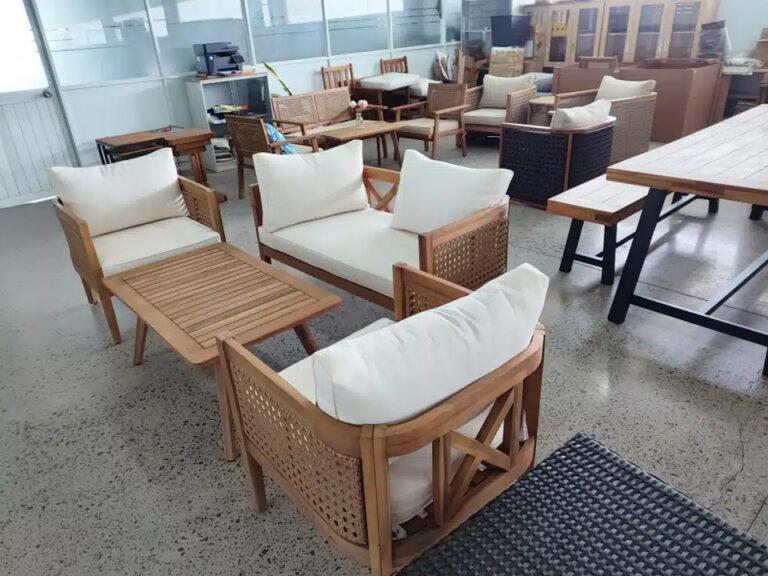
야외 가구 아이디어를 실제 제품으로 만들어 보세요
도면, 사양서 또는 아이디어를 보내 주시기 바랍니다. 당사의 엔지니어와 영업팀이 소재, 치수, 마감 처리 및 맞춤 제작 옵션을 검토해 드리겠습니다.

Cheap gets expensive. When a wholesale outdoor furniture quotation leaves material specifications, replacement freight, and delivery acceptance loosely defined, the purchasing team inherits costs that can erase the apparent saving long after the supplier has collected its deposit.
My position is straightforward: score the evidence before negotiating the discount. Outdoor furniture supplier scorecards should connect product requirements, verified performance, and commercial accountability to a purchasing decision.
That means two separate decisions: whether a supplier qualifies at all, and how competitively it performs once qualified. Mixing them allows an attractive price to compensate mathematically for an unacceptable safety problem.
I would never give a discount that much authority.
A price comparison becomes useful only after the offers describe substantially equivalent products and obligations.
~에 대해서는 rectangular patio dining set for hospitality procurement, I would request a shared specification covering dimensions, frame construction, tabletop material, finish, hardware, packaging, intended use, and the agreed delivery point.
Then I would ask each bidder to identify every deviation.
Otherwise, one supplier can quote thinner components, another can exclude protective packaging, and a third can assume a different freight arrangement. The spreadsheet still produces a winner. The comparison is still defective.
Normalize these variables before assigning price points:
My preference is to attach this baseline to the purchase agreement. An unanswered specification question should remain visible as an unresolved condition.
Recall records offer something a sales presentation rarely provides: a documented failure mechanism.
They do not disclose every procurement decision behind a product. But they give buyers concrete reasons to examine structural performance, moving parts, and traceability.
On September 14, 2023, the U.S. Consumer Product Safety Commission announced a TJX recall involving approximately 11,000 foldable bistro chairs sold under Panama Jack and House & Garden brands. The wooden frames could break or collapse; TJX reported seven incidents, including four reports of minor injuries. Sets had sold for $150–$200.
My purchasing takeaway: require evidence addressing the assembled chair’s structure and intended use. A material description cannot answer whether the complete product performs adequately.
A separate TJX recall, dated December 21, 2023, covered approximately 29,000 foldable wood-and-rope bistro chairs. The CPSC reported eight incidents of frames breaking or collapsing and six reports of minor injuries. Some sets carried Nautica or House & Garden branding.
The scorecard implication is traceability. I would require the supplier to connect the purchase order, product revision, production batch, inspection record, and shipment.
If a problem emerges, can we identify the affected inventory without treating every similar-looking chair as suspect?
On June 20, 2024, the CPSC announced Cinmar’s recall of approximately 70,000 Frontgate Resort Collection Newport Aluminum and Teak Chaises, including SKUs 67333 and 166218. An adjustable backrest could descend unexpectedly; reported injuries included two partial finger amputations and one crushing injury requiring surgery. The notice listed selling prices between $600 and $1,400.
Price proves little.
For adjustable furniture, I would require a documented assessment of adjustment mechanisms, accessible pinch points, instructions, and foreseeable use. A premium positioning statement earns no safety points in my proposed model.
These cases identify hazards worth investigating. They do not establish industry-wide failure rates or prove that a particular scorecard would have prevented the recalls.

Start with mandatory qualification conditions.
I would put a supplier on hold if it cannot establish its legal identity, identify the manufacturing location, provide the agreed product evidence, or resolve a known safety defect affecting the proposed goods.
Ask outdoor furniture manufacturers to distinguish work performed internally from outsourced welding, coating, weaving, assembly, and packing. Outsourcing itself should not trigger rejection; undisclosed responsibility makes verification difficult.
Then match the evidence to the product.
~에 대해서는 patio sofa set with ottomans for wholesale project sourcing, the purchasing brief should specify cushion construction, cover material, drainage requirements, connector hardware, and replacement-component availability.
~에 대해서는 도매용 라운지 가구 조달을 위한 독립형 직조 에그 체어, I would prioritize stability, base connections, frame construction, and the declared loading conditions.
A high woven patio bistro table and chairs for trade sourcing deserves its own review of seat height, footrests, stability, and table-to-chair compatibility.
These are proposed evaluation questions, not verified specifications for the linked products.
When reviewing a laboratory report, check the tested model, photographs, construction, test method, intended use category, date, and result. Ask a qualified laboratory to confirm which standards and requirements apply to the destination market and product.
My hard rule: a report for a similar-looking item remains unresolved evidence until the relationship is substantiated.
I would use a small set of metrics with explicit denominators and supporting records. Undefined percentages are invitations to creative reporting.
On-time, in-full delivery: Complete orders received by the original agreed delivery date divided by all orders due during the period. Record buyer-approved changes separately so date revisions remain visible.
Incoming defect rate: Inspected units containing at least one defined defect divided by total units inspected. Separate safety, major, and minor defects; state the sampling method and sample size.
Transit damage rate: Units received with transport damage divided by units received. Photograph packaging and damage before assigning responsibility.
Claim closure time: Calendar days from receipt of a complete claim to the agreed remedy being delivered. Acknowledging an email does not close a claim.
Specification conformity: Checked requirements meeting the approved specification divided by requirements checked. Keep safety requirements outside any compensating average.
Choose a consistent reporting window, such as the most recent 12 months, and show the underlying counts. “100% on time” across two orders offers less evidence than the same percentage across 80.
New suppliers should receive a provisional assessment based on verified capability and pilot results. I would leave unavailable historical metrics marked “unverified,” then limit the initial order exposure accordingly.
Here is a hypothetical comparison—not market pricing.
Supplier A quotes 1,000 chairs at $100 each. Add $15,000 in freight, duties, and handling, plus $6,000 in additional inspection, sorting, and disposal costs. If 950 chairs remain acceptable for sale, the effective cost is:
($100,000 + $15,000 + $6,000) ÷ 950 = $127.37 per acceptable chair.
Supplier B quotes $106 per chair, with the same $15,000 logistics allowance, $1,500 in additional costs, and 990 acceptable chairs:
($106,000 + $15,000 + $1,500) ÷ 990 = $123.74 per acceptable chair.
The 6% higher unit quotation produces a lower effective cost under these assumptions.
Before ordering, calculate several plausible defect and logistics scenarios. After delivery, replace assumptions with actual costs and quantities.
The following weights and purchasing thresholds are my proposed starting framework. They are not regulatory requirements or established industry benchmarks.
Set the scoring rules before reviewing bids. Otherwise, it becomes remarkably easy to adjust the model until a preferred supplier wins.
| Evaluation category | Weight | 요청할 증거 | Suggested scoring basis |
|---|---|---|---|
| Product safety and conformity | 25% | Applicable product reports, approved specifications, traceability, resolved corrective actions | Completeness and relevance of evidence, with mandatory conditions assessed separately |
| Manufacturing consistency | 20% | Inspection records, approved samples, material controls, change approvals | Conformity and defect results against agreed limits |
| Delivery and capacity | 20% | Order history, original due dates, production schedules, subcontractor disclosures | On-time, in-full performance and verified available capacity |
| Effective landed cost | 15% | Comparable quotation, logistics assumptions, defect costs, payment terms | Cost per acceptable unit under shared assumptions |
| Packaging performance | 10% | Packaging specification, shipment trials, damage records | Protection performance and observed transit damage |
| Warranty and corrective action | 10% | Written coverage, claim records, replacement lead times, root-cause reports | Remedy completion and prevention of repeated defects |
| Total | 100% | Evidence attached to each rating | Weighted score out of 100 |
Rate each category from 0 to 5 using documented criteria:
Weighted score = sum of each category’s rating ÷ 5 × its percentage weight.
A rating of 4 in manufacturing consistency contributes 16 points: 4 ÷ 5 × 20.
For an initial approval policy, I would consider 80 points a threshold for a controlled pilot, provided every mandatory condition passes. A score of 90 or more could support greater allocation after demonstrated delivery performance. Lower scores would require corrective action or another sourcing decision.
Do not quietly redistribute the weight of missing evidence. Record it, explain the resulting limitation, and keep the approval provisional.
The pilot should use the intended production materials, packaging, and inspection process. Attach the findings to the supplier record, then rescore after delivery and again after enough service time has elapsed to assess warranty performance.

An outdoor furniture supplier scorecard is a weighted purchasing framework that compares vendors using documented product safety, manufacturing quality, delivery reliability, landed cost, packaging performance, and warranty support, helping buyers decide which suppliers qualify for a pilot order, ongoing allocation, or corrective action.
Its value depends on evidence quality and consistent scoring. A precise-looking total cannot repair unreliable inputs.
Evaluating wholesale patio furniture suppliers is a structured qualification process that combines a shared product specification, verification of manufacturing responsibility, review of relevant testing, comparable cost calculations, and a controlled pilot shipment, with approval tied to documented acceptance criteria and observed performance.
I would begin with one representative product family. Approval for dining chairs should not automatically qualify a supplier’s reclining loungers.
A good supplier scorecard result is a documented score that exceeds the buyer’s predefined approval threshold while satisfying every mandatory safety and compliance condition, supported by enough relevant observations to justify the proposed order size, product category, and level of commercial exposure.
In this proposed framework, 80 points supports consideration for a controlled pilot. It does not guarantee product safety or future performance.
The best wholesale outdoor furniture suppliers are vendors whose verified product capabilities, delivery performance, effective landed costs, and corrective-action support match a buyer’s specific market and operating requirements, with sufficient evidence to support the intended order volume and no unresolved mandatory qualification failures.
I would compare candidates against the same specification and scoring rules. A generic ranking cannot resolve a project-specific purchasing decision.
Choose one product family and send every shortlisted supplier the same specification, evidence checklist, and scorecard.
Request an itemized quotation, applicable product reports, packaging details, original delivery commitments, and written warranty responsibilities. Agree on acceptance criteria before placing the pilot order.
Then score what the supplier can substantiate.
For your next wholesale outdoor furniture purchase, make a completed supplier scorecard part of the approval package before releasing the deposit.
댓글