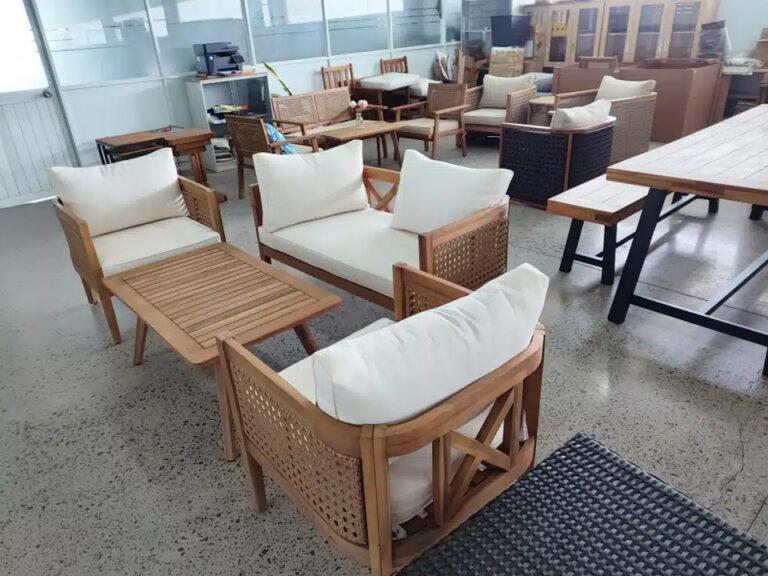
야외 가구 아이디어를 실제 제품으로 만들어 보세요
도면, 사양서 또는 아이디어를 보내 주시기 바랍니다. 당사의 엔지니어와 영업팀이 소재, 치수, 마감 처리 및 맞춤 제작 옵션을 검토해 드리겠습니다.

A polished reference sheet may contain genuine hotel names, attractive installation photographs, and technically accurate project descriptions while still concealing late deliveries, rejected batches, unauthorized subcontracting, warranty disputes, or a production scope far smaller than the supplier implies.
So what does the logo prove?
Very little, by itself.
When I assess a hotel furniture supplier, I treat every reference as an unverified claim until the hotel operator, procurement manager, designer, or main contractor confirms the project independently. That sounds severe. It is also cheaper than discovering six weeks before opening that the “manufacturer” is an exporter coordinating three unrelated factories.
The purchasing intent behind searching for the best hotel furniture suppliers is commercial, but the decision process is forensic. Buyers are not merely comparing tables and chairs. They are testing whether a supplier can reproduce an approved sample across 80, 300, or 1,000 rooms without changing the veneer, foam density, hardware, finish, packaging method, or delivery sequence.
That is where hotel furniture supplier references earn their value.

A showroom is controlled evidence. Lighting is controlled. Samples are controlled. The salesperson controls the story.
A completed hotel is different.
It exposes what happened after the quotation was accepted: whether shop drawings arrived on time, whether finishes matched the control sample, whether cartons were labeled by room, whether replacement parts appeared promptly, and whether the supplier remained responsive after receiving the final payment.
This is the hard truth about hospitality procurement: a beautiful prototype proves that a factory can make one good item. It does not prove that the same hotel furniture manufacturer can make 600 identical items, pack them correctly, load them in installation order, and deliver them during a narrow site-access window.
The reference must therefore match the risk. A supplier being considered for casegoods should provide casegoods references. A vendor bidding for pool-deck furniture should show comparable exterior projects. And a contract furniture supplier proposing a turnkey package should demonstrate coordination across guest rooms, public areas, restaurants, terraces, and back-of-house spaces.
Anything else is borrowed credibility.
Photos prove little.
A supplier can photograph a lobby it furnished only partially, show a property supplied through another trading company, or present one successful mock-up as evidence of a full production run, which is why buyers must establish exactly what was manufactured, where it was made, and who carried contractual responsibility.
Would you award a six-figure order on that evidence?
I would not.
Ask the supplier to define its scope in quantities, not adjectives. “We supplied the hotel” is vague. “We manufactured 214 headboards, 428 nightstands, 214 desks, 36 lobby tables, and 480 dining chairs” is testable.
Then separate five roles that sales materials often blur:
A hotel FF&E supplier may have coordinated a project without manufacturing the furniture. That is not automatically a problem. Concealing the distinction is.
The same skepticism should apply to audit certificates. A 2024 Reuters investigation found that two 2023 inspections reported no irregularities at an Italian luxury-goods subcontractor, yet a later police investigation alleged serious labor violations and undisclosed production arrangements. The sector was different, but the procurement lesson travels well: scheduled audits and supplier declarations can miss what happens below the first contractual tier.
Ask who actually cuts, welds, finishes, upholsters, assembles, and packs the goods.

Start with three references from projects completed during the previous 24 to 36 months. At least one should be similar in value, one similar in product mix, and one located in the destination market or operating under comparable compliance requirements.
Do not let the salesperson remain on the reference call.
Contact the property through an independently obtained telephone number or corporate email domain. Confirm that the person giving the reference actually held responsibility for procurement, design, construction, operations, or installation. A generic Gmail address and a mobile number supplied by the vendor are not enough.
My verification sequence is simple:
Repeat orders matter. Compliments do not.
The US Federal Trade Commission’s August 2024 rule prohibiting fake reviews and testimonials is another reminder that praise can be manufactured, bought, or attributed to people without real experience. The rule concerns consumer reviews rather than private procurement references, but its logic applies: identity and first-hand experience must be verified before a testimonial carries evidentiary weight.
Do not ask, “Were you happy with the supplier?” That question invites politeness.
Ask questions tied to dates, quantities, tolerances, and corrective action:
Silence is data.
If a reference avoids quantities, cannot identify the factory, or remembers only the sales representative’s first name, the relationship may be shallower than advertised. And if every answer is perfect, I become more suspicious, not less. Real hotel projects produce snags. A credible reference can describe them.
A useful final question is: “What would you write differently in the contract if you purchased from this supplier again?” That often reveals more than the previous ten questions combined.
A guest-room casegoods reference does not automatically validate exterior furniture. Different categories fail differently.
For an indoor pedestal table, buyers might investigate base stability, coating consistency, packing damage, and top-to-base alignment. A reference involving a round textured black pedestal table for wholesale sourcing is therefore more relevant than a generic restaurant-chair installation.
For lounge areas, ask whether tables scratched, rocked, stained, or changed color under cleaning chemicals. A comparable round gray drum coffee table for hotel projects gives the reference contact something specific to discuss: finish durability, edge damage, weight, and replacement performance.
Exterior scopes need another level of questioning. A buyer reviewing a freestanding louvered pergola for outdoor project sourcing should ask about drainage, wind calculations, fasteners, installation tolerances, water ingress, spare motors if applicable, and local structural approvals.
Materials matter too. Type 304 stainless steel and Type 316 stainless steel are not interchangeable beside a saltwater pool. Aluminum 6063-T5, powder-coating pretreatment, UV resistance, drainage design, and dissimilar-metal corrosion can determine whether the installation still looks acceptable after two wet seasons.
~에 대해서는 cylindrical gray decorative planter in a wholesale hotel scheme, ask about loaded weight, liner design, drainage, freeze-thaw exposure, surface staining, and whether irrigation damaged the finish.
And fire features deserve their own reference trail. Before sourcing a 투명한 테두리가 있는 둥근 파티오 화로, confirm who supplied the burner system, which party handled gas or electrical certification, what fuel was used, and whether wind guards, shutoff controls, clearances, and local approvals were included in the contractual scope.
A photograph cannot answer those questions.

Reference checking should confirm regulatory competence as well as appearance.
For US hotel bedroom storage, the Consumer Product Safety Commission states that 16 CFR Part 1261 applies to covered clothing storage units manufactured after September 1, 2023. The rule incorporates ASTM F2057 and covers qualifying freestanding units that are at least 27 inches high, weigh at least 30 pounds, and provide at least 3.2 cubic feet of enclosed storage.
That is wonderfully specific. Your supplier’s evidence should be equally specific.
Do not accept “CPSC compliant” in an email. Request the applicable test report, model identification, laboratory name, issue date, tested configuration, warning labels, anti-tip hardware details, and written confirmation that production units use the tested construction.
For upholstered furniture, request the fire-performance standard named in the project specification. Depending on the destination and application, that may involve standards such as CAL TB 117-2013, NFPA 260, EN 1021-1/2, or BS 7176. The correct requirement must come from the project’s code consultant or authority having jurisdiction—not from a salesperson copying language from an old quotation.
For composite wood, ask about formaldehyde, CH₂O, documentation under the relevant market rules, and the identity of the actual panel producer. For exterior metals, request coating-system details and salt-spray or corrosion evidence where the environment warrants it.
A reference should confirm that these documents arrived before production, not after customs clearance.
Supplier verification does not end when the reference calls sound positive.
Confirm the beneficiary name on the bank account matches the contracting entity. Verify any changed payment instructions through a known telephone number. Require two-person approval for beneficiary changes, and never rely solely on an email chain that contains new wiring details.
In its 2024 Internet Crime Report, the FBI recorded 21,442 Business Email Compromise complaints and reported losses of $2,770,151,146. The comparable 2023 loss was $2,946,830,270. Those numbers make payment verification a procurement control, not an administrative courtesy.
I also want the quotation, pro forma invoice, purchase order, factory license, export documents, and bank account to tell the same corporate story. If four different company names appear, stop and map the relationships.
There may be a legitimate manufacturer, exporter, sales agent, and payment company. But the buyer should know which entity owns the tooling, which entity holds the deposit, which entity signs the warranty, and which entity can be sued.
Messy paperwork predicts messy accountability.

Use a weighted score rather than letting one enthusiastic reference dominate the decision.
| Verification Area | Weight | Strong Evidence | Weak Evidence or Red Flag |
|---|---|---|---|
| Comparable project scope | 20% | Similar room count, product mix, value, and timeline | A small café or sample room presented as a hotel project |
| Independent identity check | 15% | Corporate email, hotel switchboard, verified job role | Personal email or contact reachable only through the supplier |
| Delivery performance | 15% | Dates, shipment records, and measurable on-time performance | “Delivery was generally fine” |
| Quality consistency | 15% | Batch data, snag rate, inspection reports, corrective records | Only staged photographs |
| Defect response | 10% | Named issue, response time, replacements, root-cause action | Reference claims nothing ever failed |
| Compliance documentation | 10% | Model-specific, dated reports tied to production goods | Generic certificates or unrelated test samples |
| Manufacturing transparency | 10% | Factory identity and subcontractors fully disclosed | Supplier refuses to identify production sites |
| Repeat business | 5% | Second purchase order or active follow-on project | Praise without another order |
I would reject any supplier scoring below 70%, even when its price is attractive. A score of 70% to 84% calls for stronger contract controls, third-party inspection, and a limited pilot order. At 85% or above, the supplier may advance—but references still do not replace sample approval, pre-production testing, inline inspection, and final random inspection.
Watch for these warning signs:
That final claim is common nonsense. Specialist hardware, glass, stone, foam, fabric, lighting components, burners, motors, and coatings often come from outside vendors. Good suppliers manage those dependencies openly. Weak suppliers pretend the dependencies do not exist.
Hotel furniture supplier references are independently verifiable accounts from hotel owners, operators, designers, contractors, or procurement professionals who directly managed a supplier’s completed work and can confirm its scope, quantities, quality, delivery performance, defect response, manufacturing role, compliance documentation, and willingness to support the project after payment.
A testimonial on a supplier’s website is not enough. Buyers should verify the contact’s identity independently, confirm the project dates and quantities, and compare the account against purchase documents, photographs, test reports, inspection records, and the supplier’s stated production role.
A hotel furniture supplier should normally provide at least three recent references: one matching the proposed order’s approximate value and volume, one covering the same furniture category, and one operating under similar destination-market regulations, installation conditions, environmental exposure, and delivery constraints within the previous 24 to 36 months.
For a high-value or multi-property rollout, I would ask for more. References should cover both successful delivery and after-sales performance, because the supplier’s behavior after defects appear is often more revealing than the initial shipment.
A genuine hotel reference is verified by contacting the property or corporate group through independently sourced details, confirming the referee’s professional role, validating the project name and completion date, checking the supplier’s precise contractual scope, and comparing the answers with dated photographs, purchase records, shipment evidence, inspection documents, and repeat-order history.
Never rely only on the telephone number provided by the sales representative. Call the hotel switchboard, use the company’s official domain, or contact the project designer or main contractor through a separately verified channel.
The best reference questions request measurable facts about delivery dates, ordered quantities, rejected items, finish consistency, installation problems, response times, replacement costs, subcontracting, documentation, and warranty support, while also asking whether the client would appoint the same supplier again for a project of equal size, complexity, and commercial risk.
Avoid broad satisfaction questions. Ask what failed, how quickly it was corrected, who paid for the correction, and what the buyer would change in a future contract.
Hotel references are necessary but insufficient evidence because they describe past performance without proving that the current factory, workforce, materials, financial position, subcontractors, production capacity, quality controls, or compliance documents remain unchanged for the buyer’s specific products, quantities, destination market, installation sequence, and required completion date.
References should sit beside factory verification, sample approval, test-report authentication, contract review, financial checks, production inspections, packing standards, shipment controls, and a documented defect-resolution process.
Do not ask a hotel furniture supplier for “some client names.” Ask for comparable evidence.
Verify the people. Confirm the quantities. Trace the factory. Test the documents. Call the hotel without the salesperson listening. And ask what went wrong.
That last question matters.
A supplier with a documented failure, followed by fast and competent corrective action, may be safer than a supplier claiming a spotless record that nobody can independently confirm.
Before approving your next hotel FF&E supplier, build a reference scorecard around the exact furniture package, destination regulations, opening schedule, and warranty exposure. If the evidence survives that scrutiny, proceed to sampling and inspection. If it does not, walk away before the deposit makes the decision for you.
댓글